
Case Study
From Processing Fees to Full Scholarships: How One Chamber Turned Everyday Business Activity Into $35,000 in Community Funding
Regional Chamber of Commerce • OMS & KSF Founding Chamber Partner
Regional Chamber of Commerce
OMS & KSF Founding Chamber Partner
Overview
When the executive director of a small regional chamber of commerce first sat down with the Oracle Merchant Services team, she was not looking for a processing solution. She was looking for a way to do something meaningful for the students in her community — young people who had grown up watching their families and neighbors build small businesses along streets and in storefronts that the chamber had spent decades supporting. The desire to invest in those students' futures had always been present. What had been missing was a sustainable, administratively manageable way to turn that desire into funded reality.
This case study documents how that chamber — with fewer than 60 active member businesses and a modest operating budget — built a scholarship fund from scratch, funded seven college and university scholarships totaling $35,000, reduced processing expenses for 11 participating member businesses by an average of 39%, and did all of it without a single external grant application, fundraising campaign, or dues increase. It is, in the simplest terms, a story about what becomes possible when the right structure meets the right community.
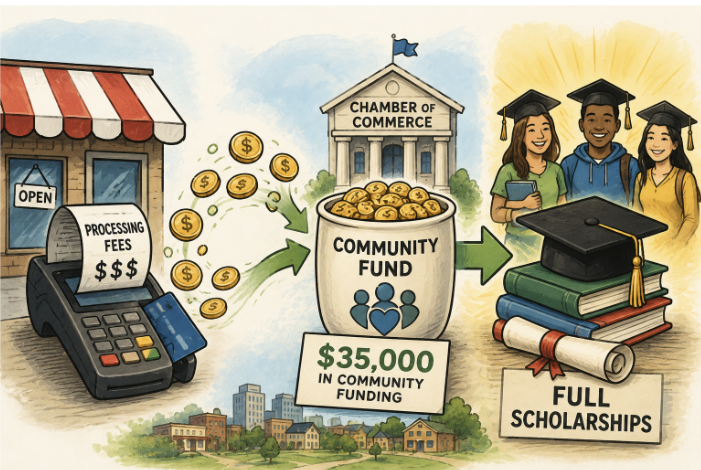
What changed the conversation was the introduction of the OMS & Kaleidoscope Foundation Community Scholarship & Grant Initiative — and its core structural insight: that scholarship funding does not have to be generated through donations. It can be generated through commerce.
Challenges Before Oracle Merchant Services
The chamber had, for several years, discussed the idea of a scholarship program at its annual leadership planning retreats. The conversations always arrived at the same wall: scholarships require a funding pipeline, and funding pipelines require either a donor development program, a dedicated grant-writing effort, or a recurring fundraising infrastructure — none of which the chamber had the staff capacity, budget, or bandwidth to build and maintain alongside its existing programming obligations.
The chamber's membership was predominantly composed of small and independent businesses — restaurants, retail shops, service providers, a handful of professional offices. These were businesses that cared deeply about their community and were generally willing to support the chamber's initiatives, but had limited appetite for additional financial asks on top of their existing membership dues. Any scholarship program that depended on annual donations from member businesses was unlikely to be sustainable, and the chamber's leadership knew it.
Solution Implemented by Oracle Merchant Services
When the chamber enrolled as an OMS & KSF Founding Chamber Partner, the first phase was a direct collaboration with the OMS and KSF teams to structure the program around the chamber's specific community goals. This customization phase — which carries no cost or obligation — addressed several key decisions:
Program Customization
- Fund naming: The chamber named its co-branded scholarship fund in honor of a longtime community leader whose family had deep ties to local small business culture.
- Award categories: The chamber chose to focus exclusively on educational scholarships in the initial cohort — splitting awards between community college students and four-year university students, with an emphasis on first-generation college attendees.
- Eligibility criteria: Candidates were required to reside in the chamber's defined service area, demonstrate financial need, and submit a short essay on the role small business plays in community development.
- Minimum award: The chamber set a minimum award of $5,000 per recipient — a threshold meaningful enough to make a real difference in a student's ability to complete a degree program without deferring enrollment.
Foundation-Administered Fund
- Once the fund structure was established, the Kaleidoscope Foundation — a federally recognized 501(c)(3) nonprofit that administers over $9 million in scholarship and grant funding annually nationwide — assumed full responsibility for fund administration, compliance, application management, and disbursement.
- The chamber retained direct authority over finalist selection and community engagement but carried zero administrative burden in operating the fund.
Member Engagement: Getting to 11
- The chamber introduced the program to its membership through its existing monthly newsletter, a presentation at the next quarterly member meeting, and a series of one-on-one outreach conversations facilitated by the OMS team using co-branded materials provided at no cost to the chamber. The message was kept deliberately simple: switch your payment processing to Oracle Merchant Services, reduce your current processing fees significantly, and your business activity will directly fund scholarships for students in this community.
- In the first enrollment wave, 11 businesses opted in — a participation rate that exceeded the chamber's internal projections for year one. The businesses that enrolled represented a cross-section of the chamber's membership: a family-owned restaurant, two retail boutiques, a dental practice, an auto service shop, a professional cleaning service, a construction contractor, a hair salon, a legal services office, and two e-commerce businesses with local ownership. Together they represented a monthly processing volume that, when aggregated, created a meaningful and sustainable fund contribution stream.
Seamless Onboarding
- The OMS team managed all onboarding logistics for each participating business — equipment deployment, contract transition support, account setup, and rate configuration — at zero cost to the businesses or the chamber.
- Every participating merchant received a free POS equipment upgrade as part of the transition, with several businesses receiving terminal technology that was meaningfully newer and more capable than what they had been operating on for years.
- Not a single business experienced downtime or service interruption during the transition. The switch was operationally invisible.
Results Achieved
Savings Across Participating Businesses
- Across the 11 participating businesses, the financial impact of the transition was immediate and consistent. The average reduction in monthly processing expenses was 39% — a figure that, while it varied by business based on prior provider rates and processing volume, represented real operational savings for every account from the moment of activation.
Scholarship Fund Growth
- As those accounts processed transactions over the course of the program's first annual cycle, a portion of the revenue OMS generated from those accounts flowed directly into the chamber's co-branded scholarship fund administered by KSF. By the end of the cycle, the fund had accumulated sufficient capital to fund the chamber's target award structure. The chamber's scholarship committee, working in partnership with KSF through the real-time fund portal, reviewed applications and selected seven recipients — each receiving a $5,000 award.
Students Funded
- Of the seven recipients, four were enrolled in four-year university programs and three were entering community college. All seven came from households whose income levels placed them in the bottom half of their region's economic distribution. For several, the $5,000 award represented the difference between enrolling on time and deferring for a semester to save money — a deferral that, statistically, dramatically increases the likelihood of never returning to complete a degree.
Business Recognition & Goodwill
- Every participating business was publicly recognized as a co-sponsor of the scholarship fund — appearing by name in all chamber communications related to the awards, in the KSF program documentation, and in the press release distributed at the scholarship ceremony. In a community where business reputation is built on relationships and local identity, that recognition carried weight that most marketing spending cannot easily replicate.
- Several business owners reported that customers had come in specifically because they had seen the business mentioned in connection with the scholarships. Long-standing customers expressed appreciation and loyalty that the business owners described as genuine and lasting. One restaurant owner noted that three separate customers had mentioned the scholarship program as the reason they had chosen her establishment over a competitor — entirely unprompted.
Community Celebration
- The chamber's annual scholarship celebration became one of the most attended events in its recent history, drawing scholarship recipients and their families, participating business owners, local media, and community members into the same room to witness an outcome that none of them had been able to produce individually. The chamber's executive director described it as the moment the organization's membership most fully understood what the chamber was actually for.
Client Testimonial
“We weren't asking our members to give anything extra. We were asking them to redirect what they were already spending — on processing fees they were already paying — through a provider whose model sent part of that revenue back into our community.”
Chamber Executive Director
OMS & KSF Founding Chamber Partner
This case study is not a story about a uniquely resourced or exceptionally well-connected chamber. It is a story about a small organization that found a structural mechanism that aligned the financial interests of its member businesses with the community priorities of its leadership — and then executed it consistently over twelve months. The OMS & KSF model does not ask chambers to fundraise. It does not ask member businesses to donate. It asks both to redirect existing commercial activity through a structure that produces better outcomes for everyone involved. Businesses reduce costs. The chamber gains a scholarship fund and a compelling new member value proposition. The community receives educational funding that would not otherwise exist. And the Kaleidoscope Foundation provides the administrative infrastructure that makes the entire ecosystem compliant, transparent, and professionally managed. To date, Oracle Merchant Services and the Kaleidoscope Foundation have collectively raised over $800,000 in scholarship and grant funding through this model. The chamber featured in this case study contributed to that total with 11 businesses and a clear community goal. Larger chambers, with more member businesses and deeper processing volumes, have historically generated $50,000 or more in co-branded funding within a single annual cycle. The question is not whether this model works. The question is whether your organization is ready to be the next chamber that proves it.



Ready to Reduce Your Processing Costs?
Get a free, no-obligation rate review and see how much you could save.